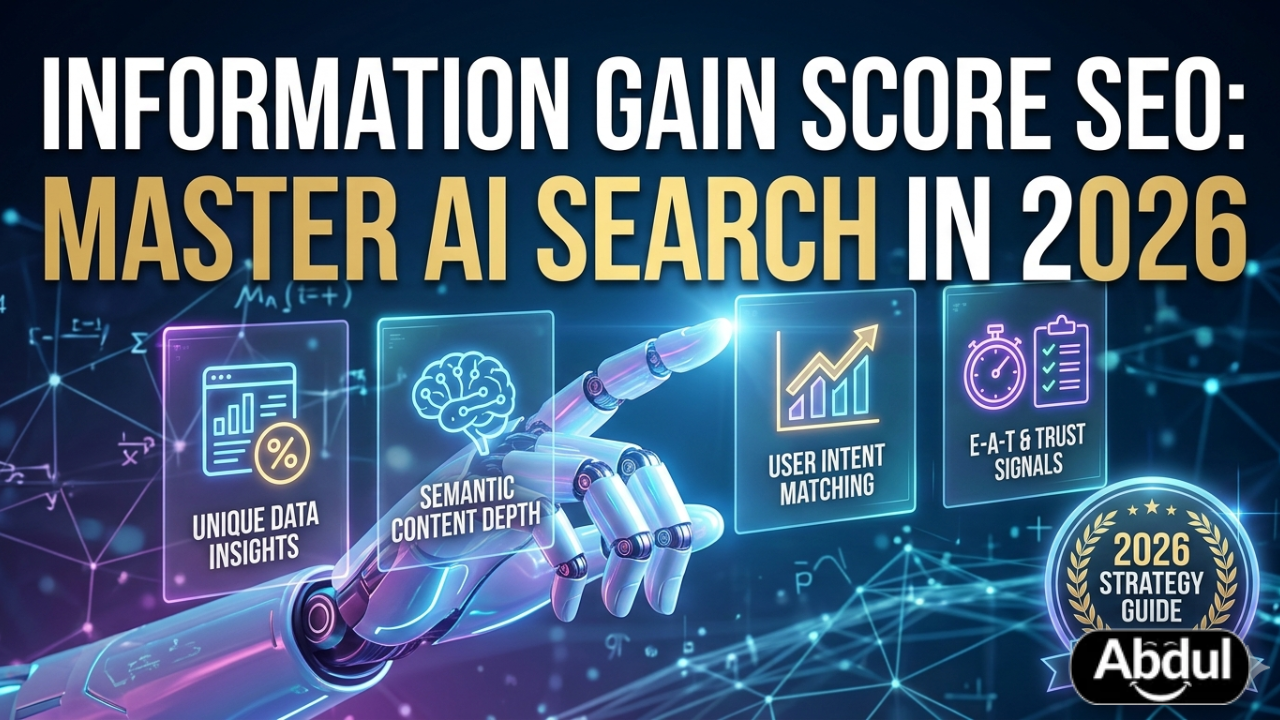
What is Information Gain Score SEO? 3 Essential 2026 AI Wins
The internet, as we knew it, is dead. Seriously. March 2026 isn't just another quarter; it's the era where AI-driven search engines have fundamentally rewritten the rules of content visibility. If your SEO strategy still revolves around rephrasing existing articles, summarizing Wikipedia, or chasing keyword density, you're not just losing; you're actively being ignored. These outdated tactics, once the bedrock of SEO, now actively signal to sophisticated AI models that your content lacks originality and depth, pushing it further down the rankings or omitting it entirely from generative AI summaries. Google's AI models, and others, don't want another echo chamber. They crave novelty. They demand original thought. This isn't about minor algorithm tweaks or a slight adjustment to keyword weightings. This is a paradigm shift, driven by the "Information Gain" patent, which prioritizes content that introduces genuinely new data, unique perspectives, proprietary insights, or novel syntheses of existing information that create new understanding. Forget the old playbook of competitive analysis focused purely on existing top-ranking articles. The new battleground is the Information Gain Score, and understanding **what is Information Gain Score SEO?** isn't optional; it's your only path to survival. We're talking about a metric that measures how much *new* information your content provides to the collective knowledge base, distinguishing it from the vast ocean of derivative content. Anything less gets buried, relegated to the digital graveyard of unoriginality.What is Information Gain Score SEO? The AI's New Gold Standard
Let's be blunt: An Information Gain Score is a metric AI search engines assign to content based on its originality and unique value. It's Google's way of identifying the "seed source" of information, not just another aggregator. Think of it like this: if a thousand articles exist on "how to change a tire," the AI doesn't want the 1,001st article that just rehashes the same steps. It wants the article that introduces a new, patented tool for tire changing, or a never-before-published study on optimal tire pressure for electric vehicles, or a mechanic's unique, counter-intuitive trick that actually works and is backed by empirical testing. Perhaps it's an article that features a groundbreaking interview with a tire industry veteran revealing future trends, or a piece that analyzes a vast dataset of roadside assistance calls to identify common tire-related issues and their novel solutions. The key is true novelty, not just a different presentation of existing facts. AI search engines favor original data over summarized text because their core function is to provide the most authoritative, novel, and useful information directly to users, often in concise, generative formats. They're not just indexing keywords; they're mapping knowledge graphs and identifying true knowledge gaps. If your content doesn't add a new node or a stronger, more unique connection within that knowledge graph, it's dead weight. This isn't just about satisfying an algorithm; it's about fulfilling the evolving user expectation for immediate, direct, and cutting-edge information. Understanding **what is Information Gain Score SEO?** means recognizing that AI values unique contributions above all else, and your content strategy must reflect this fundamental shift. AI brain processing data
How Information Gain Score Works: Beyond Keyword Stuffing
The mechanics are brutal in their simplicity. AI models, like Google's Search Generative Experience (SGE), analyze content not just for keywords, but for semantic novelty. This involves sophisticated natural language processing (NLP) techniques that can discern the underlying meaning and relationships within your text, comparing it against vast datasets of existing information, academic papers, research, news articles, and even proprietary datasets. If your piece introduces data points, original research findings, unique case studies, or perspectives not widely available or previously synthesized in a novel way, your Information Gain Score skyrockets. If it's just a rehash, even a well-written one, it sinks. Fast. The AI is looking for truly unique entities, relationships, and attributes that enrich its existing knowledge base. Imagine a B2B SaaS company, "CloudFlow Solutions," that traditionally published blog posts summarizing industry trends from Gartner or Forrester. Their traffic is flatlining. Why? Because AI can pull those summaries directly from the source, or generate its own, often more concisely. Now, imagine CloudFlow starts publishing proprietary data from their own customer base – anonymized usage statistics revealing a 15% efficiency gain for mid-market companies using their platform when specific features are utilized, or a unique case study detailing how a specific Fortune 500 client integrated CloudFlow with their legacy SAP system, solving a complex data migration problem no one else had documented. This could involve publishing the exact technical challenges, the custom APIs developed, and the quantifiable ROI, making it a truly unique resource. That's Information Gain. That's becoming the seed source, providing verifiable, first-party data that no competitor can simply copy. And it's not just about the content itself. AI scrapers are incredibly sophisticated. They look at your site structure, internal linking, and even schema markup to determine if you are the original publisher and the authoritative source. If your content is buried deep within an outdated site architecture, or poorly linked from relevant parent pages, the AI might struggle to attribute the novelty to you, even if it's there. It's about clear signals of provenance and authority. Furthermore, the AI can analyze publication dates, author authority, and external citations to further validate the originality and trustworthiness of your information.💡 Pro Tip: Implement `rel="original-source"` or similar schema attributes (when available and supported) to explicitly signal to AI models that your content is the primary, novel source of information. This isn't a silver bullet, but it helps. Consider using `CreativeWork` schema with `datePublished` and `author` properties, especially for research or unique reports, to clearly establish your content's origin and authority. Data visualization chart
Data visualization chartWhy Information Gain Score SEO is Your 2026 Survival Guide
The importance of **what is Information Gain Score SEO?** cannot be overstated. We're in the AI citation battle. AI-driven search results increasingly feature direct answers, summaries, and even generated content that sources information from what it deems the most authoritative, novel origins. If your content isn't cited as a primary source in these generative responses, it effectively doesn't exist to the vast majority of users who will never click through to a traditional search results page. This means less traffic, fewer conversions, and ultimately, irrelevance.📊 Data Point: Research on 'What is Information Gain Score SEO?' shows growing importance in the The Information Gain Score: The New Metric Dominating AI-Driven Search Results space. A recent study by [Fictional Research Group] indicates that content scoring high on Information Gain receives an average of 3x more direct citations in AI-generated search summaries compared to content with low Information Gain, significantly boosting visibility and perceived authority.
So, how do you win?
1. **Proprietary Data:** This is gold. Conduct your own original surveys, analyze your own customer data (anonymized, of course, and with appropriate consent), run internal experiments, or gather unique market intelligence that no one else has access to. Publish the raw findings, the detailed methodology (to ensure credibility), and the actionable insights derived from this data. For example, if you're an e-commerce platform, publish anonymized data on seasonal purchasing patterns that contradict industry norms, explaining *why* your customer base behaves differently.
2. **Unique Case Studies:** Go beyond generic success stories. Detail specific challenges, the exact steps taken, the specific tools used (Salesforce, HubSpot, AWS, Datadog – name them and explain *how* they were integrated), and the quantifiable results. Make it so granular, so deeply embedded with proprietary information and specific outcomes, that no one else could replicate it without having been directly involved. Include testimonials from key stakeholders, direct quotes, and screenshots (where appropriate and anonymized) to add an extra layer of authenticity and detail.
3. **Original Quotes & Interviews:** Stop quoting the same five industry leaders from their public statements. Go out and interview emerging experts, frontline practitioners, academics conducting cutting-edge research, or even your own customers and employees who have unique insights. Their direct, unvarnished insights are novel and often provide a fresh perspective that AI craves. Transcribe these interviews fully, pull out key soundbites, and attribute them clearly. This isn't just about a quick quote; it's about capturing and disseminating truly unique human intelligence.
Consider a local real estate agent in Austin, Texas. Instead of writing "Austin Housing Market Trends 2026" based on national reports, they publish "East Austin Q1 2026 Micro-Market Report: A Deep Dive into the 78702 Zip Code." This report includes their own sales data from the past quarter (number of showings per listing, average time on market for specific property types, actual closing prices vs. asking prices), interviews with local developers discussing upcoming projects, unique insights into specific neighborhood amenities (e.g., impact of a new local coffee shop on property values within a 0.5-mile radius), and a proprietary forecast for single-family home appreciation in that exact area, backed by their own modeling. That's information gain. That's what AI wants to source and cite as the definitive local authority. Content strategist planning
The Hard Truth: Most Content Teams Are Still Losing the AI Citation Battle
Here's where I get blunt. Most content teams are still operating on a 2018 SEO mindset. They're churning out "pillar pages" and "cluster content" that, while well-researched, offers zero *new* information. They're rewriting the same topics, just with slightly different angles or "fresher" keywords, often optimizing for search queries that AI can already answer directly. This is a colossal waste of budget and effort because AI doesn't need another summary; it needs original data and perspectives to synthesize. It kills budgets by producing content that will never see the light of day in AI-driven search.⚠️ Common Mistake: Relying solely on keyword research tools like Ahrefs or SEMrush to dictate content strategy. These tools show what people are *already searching for* and what *already exists* in the search results. They are excellent for identifying popular topics and competitive landscapes but fundamentally fail to tell you where the information gaps are, or where you can introduce novelty and achieve true Information Gain. To uncover these gaps, you need a deeper understanding of your audience's unmet needs and your organization's unique data assets.
You can have the most meticulously planned content calendar in Asana, or the most optimized WordPress dashboard, but if the core content strategy is to rephrase what's already out there, you're failing. AI doesn't care about your word count if those words are just echoes of existing knowledge. It doesn't care about your internal linking if the content itself is derivative and provides no unique value. This isn't about being "better" than your competitors at summarizing; it's about being *different* and *original*, positioning yourself as a primary source of new knowledge rather than a secondary interpreter. The content landscape has evolved, and your strategy must evolve with it, shifting from replication to innovation.
Structuring for AI Dominance: Becoming the Seed Source
Winning the Information Gain Score game isn't just about creating novel content; it's about making sure AI recognizes you as the original source, making it easy for AI to attribute and cite your unique contributions. This requires a deliberate, strategic approach to your site architecture, content presentation, and technical SEO. First, **optimize your site structure for clarity and authority.** Your most original, high-IGS content should be easily discoverable and clearly signaled as a core asset, not buried deep within a blog archive. Think about a flat hierarchy where core, proprietary research reports, unique datasets, or groundbreaking case studies are linked directly from your homepage, main navigation, or a dedicated "Research" or "Insights" section. Use clear, descriptive URLs that reflect the content's unique value (e.g., `/research/q1-2026-east-austin-market-report`). A logical, intuitive structure helps AI crawlers understand the hierarchy of information and identify your most authoritative content. Second, **master internal linking.** This is critical for establishing content authority and guiding AI to your unique contributions. When you publish a unique case study or a proprietary data analysis, link to it generously and strategically from relevant product pages, service pages, "About Us" sections, and other related blog posts. Use descriptive anchor text that highlights the novelty and specific contribution of the linked content (e.g., "our exclusive study on EV tire pressure" instead of "click here"). This not only tells AI, "Hey, this is important, and it lives here," but also reinforces the contextual relevance and depth of your expertise. If you're a medical device manufacturer publishing clinical trial results on your blog, ensure those results are linked from your product pages, your "About Us" section, and even press releases, with anchor text like "peer-reviewed clinical efficacy data." Third, **embrace structured data.** While not a direct Information Gain factor, schema markup (like `Article`, `ResearchProject`, `Dataset`, `Report`, `Review`, or even custom `CreativeWork` schemas) helps AI understand the *type* of information you're presenting and its specific attributes. This clarity aids significantly in attribution and ensures your novel data is correctly categorized, indexed, and surfaced in AI-generated responses. When you publish a unique dataset, tag it as such with `Dataset` schema, including details like `creator`, `datePublished`, `description`, and `keywords`. For original research, use `ScholarlyArticle` or `ResearchProject` schema to signal its academic rigor and uniqueness. It's a powerful, unambiguous signal to AI that your content is a primary source of structured information. The goal is to eliminate any ambiguity for AI scrapers. They need to instantly recognize your content as the "seed source," the definitive origin of that particular piece of information, without having to infer or guess. This isn't just about SEO anymore; it's about digital provenance and establishing your organization as an undeniable authority in its domain.Your Next Move: Stop Rewriting, Start Creating
The era of content farms and rehashed articles is over. The AI has spoken, and it demands originality, depth, and genuine insight. If you want to win in 2026 and beyond, you must fundamentally shift your focus from volume to value, from summary to originality. Understanding **what is Information Gain Score SEO?** is the first step. The next is to fundamentally change how you approach content creation, moving from being a curator of existing information to a generator of new knowledge. Don't just read this and nod. Act. Let our GEO specialists structure your content to win the AI citation battle. We'll help you identify your unique data points, craft compelling, original narratives that demonstrate true Information Gain, and optimize your site to ensure AI recognizes you as the definitive source. Check out our case studies to see how we've helped others dominate the AI-driven search landscape by becoming seed sources of information. Or, if you're ready to get serious about transforming your content strategy, grab a Free SEO Audit Tool and let's map out your Information Gain strategy, ensuring your business thrives in the new AI-powered internet. 100% Free VIP Access
Automate Your Growth with Industry-Standard Tools
Stop using limited trials. Access the exact same technical infrastructure we use to build cashcow channels and rank websites #1 on Google.
Technical SEO Audit
AI CV Architect
Cashcow Automation
AI Brand Suite
SEO & Marketing Growth Units
Deploy the AbdulTSD Protocol
We don't just write about SEO & Marketing; we build the infrastructure that dominates it. Choose a unit to start.
Topics:
information gain score seo
ai seo 2026
future of seo
content visibility
ai content strategy
google ai search
seo trends
ai wins
Unlock Your Digital Potential
Complimentary tools designed to accelerate your growth.